The short version
Many rural parcels are served by private roads that predate modern fire code. California Fire Code (CFC) §503 expects roughly a 20-ft clear width, 13'6" vertical clearance, an all-weather surface rated for fire apparatus, and adequate turnarounds. On steep or forested lots, bringing an existing road to that standard is often physically or economically impossible — and the fire authority (the AHJ) can withhold clearance on that basis and block the permit.
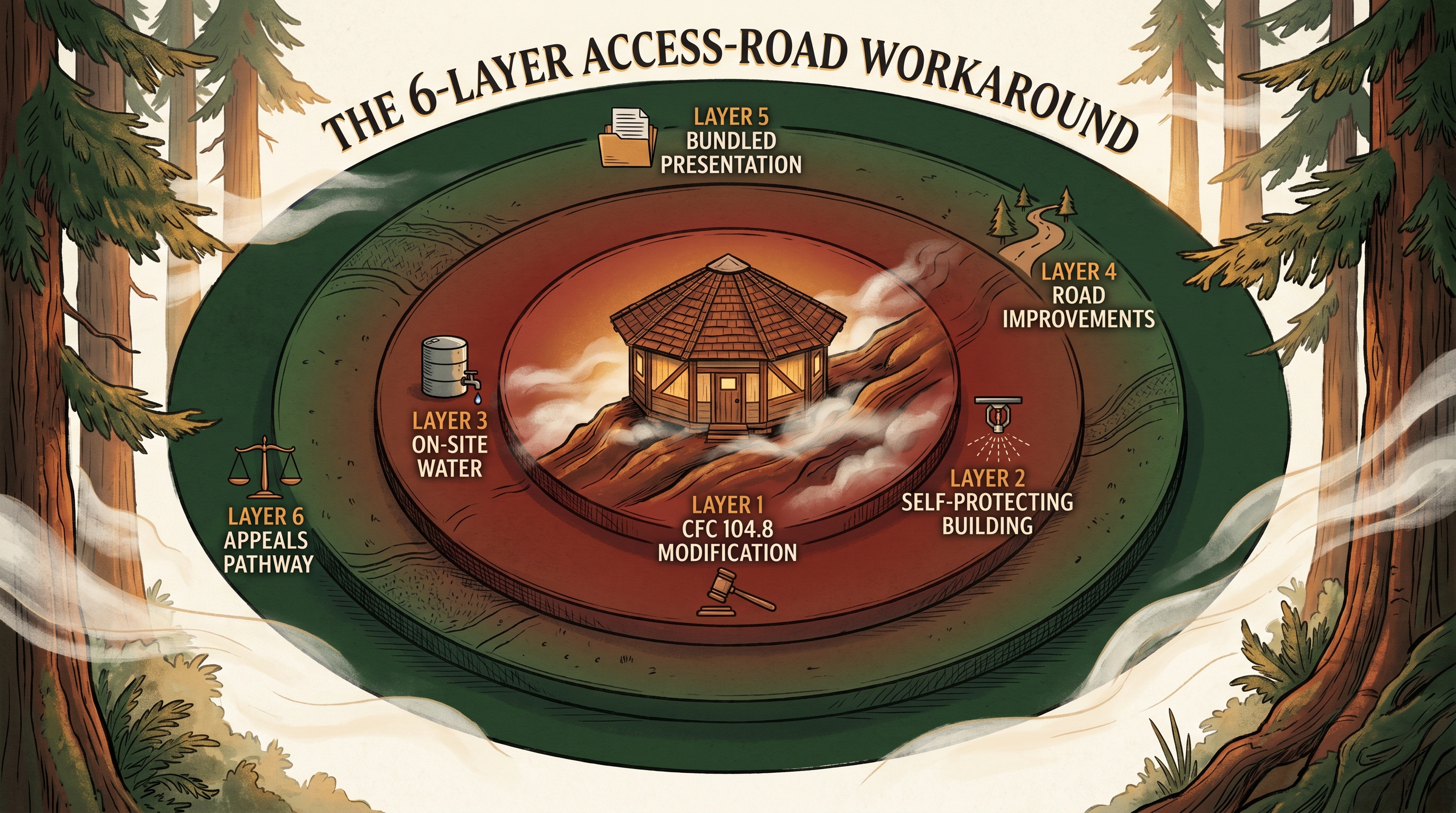
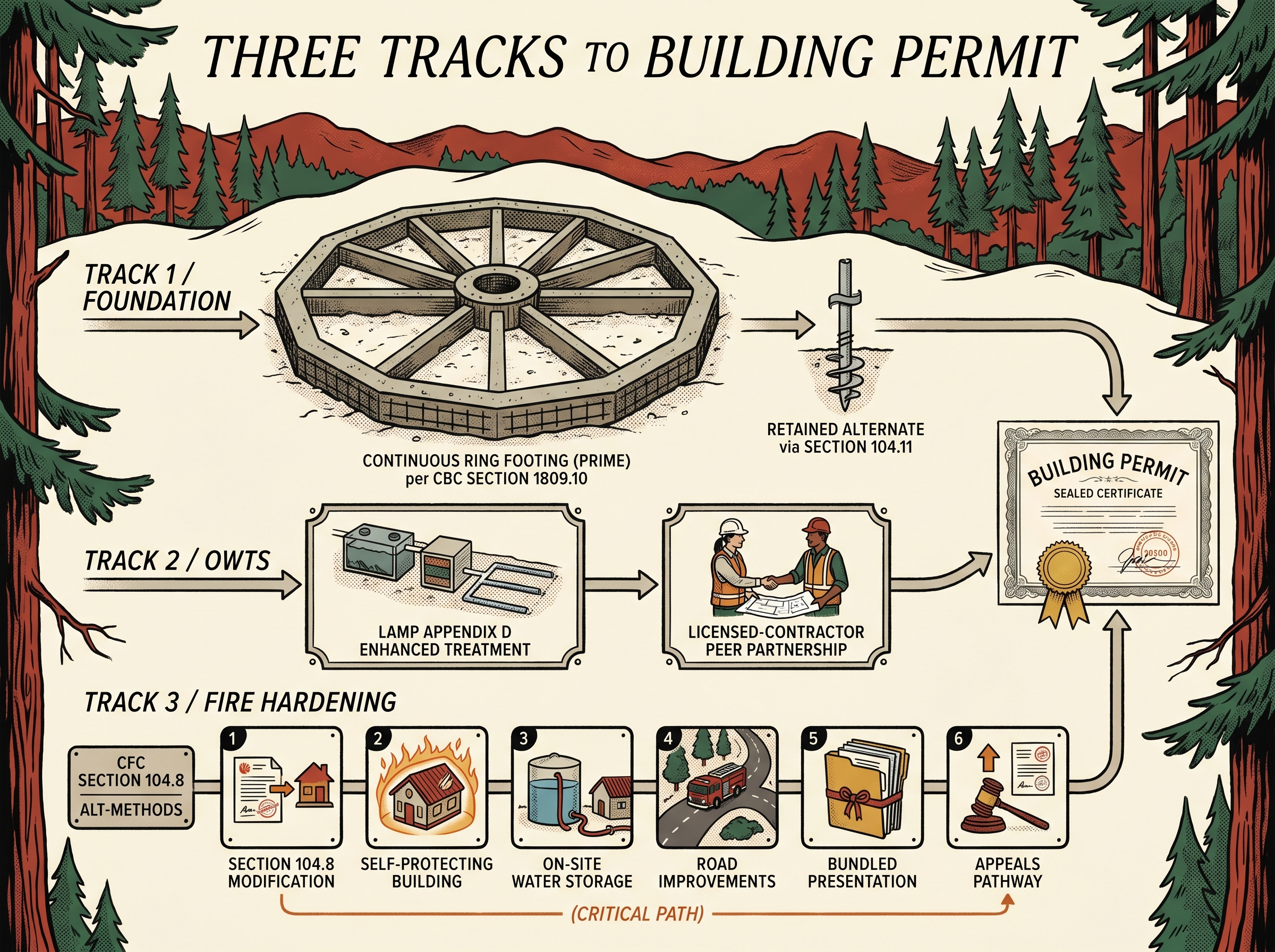
The approach, in six moves:
- Invoke the CFC §104.8 modification mechanism — the code's own built-in alternative-compliance path.
- Make the building self-protecting (NFPA 13D residential sprinklers + CBC Chapter 7A WUI construction).
- Put water on-site (code-minimum fire-water storage in a prescriptive configuration).
- Make targeted road improvements at the pinch points that actually matter.
- Present everything as one bundled package at a pre-application meeting.
- Keep an appeals pathway ready in reserve.
The whole mitigation envelope is modest — and far below the cost of full road reconstruction.
The strategic reframe
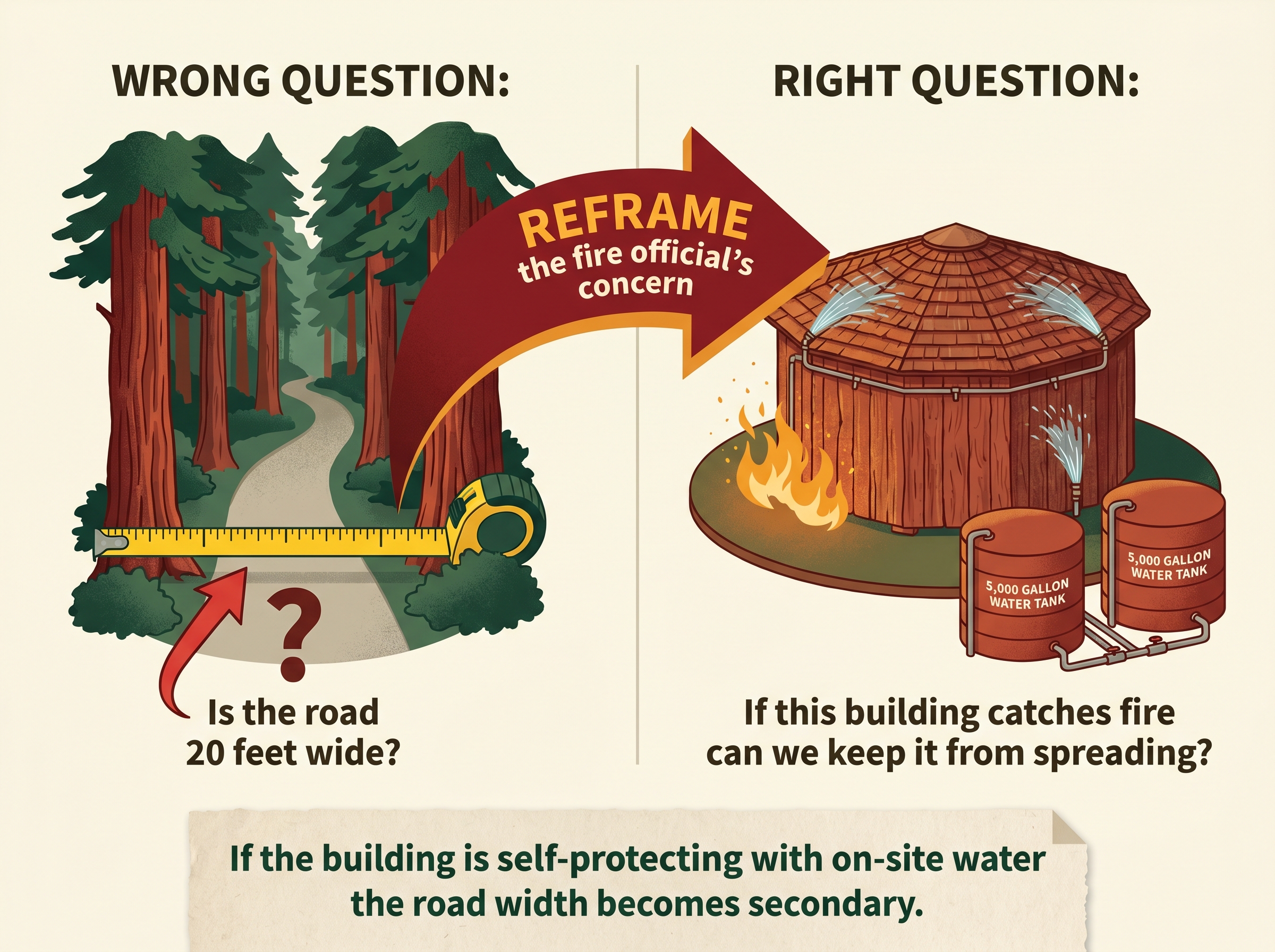
The fire authority's real concern is not "is this road exactly 20 feet wide." It is: "If this building catches fire, can we keep it from spreading — and can we protect anyone inside?"
If the building is self-protecting, with water on-site, the road width becomes secondary rather than determinative. Every layer below serves that reframe.
The six layers
1. CFC §104.8 modification request
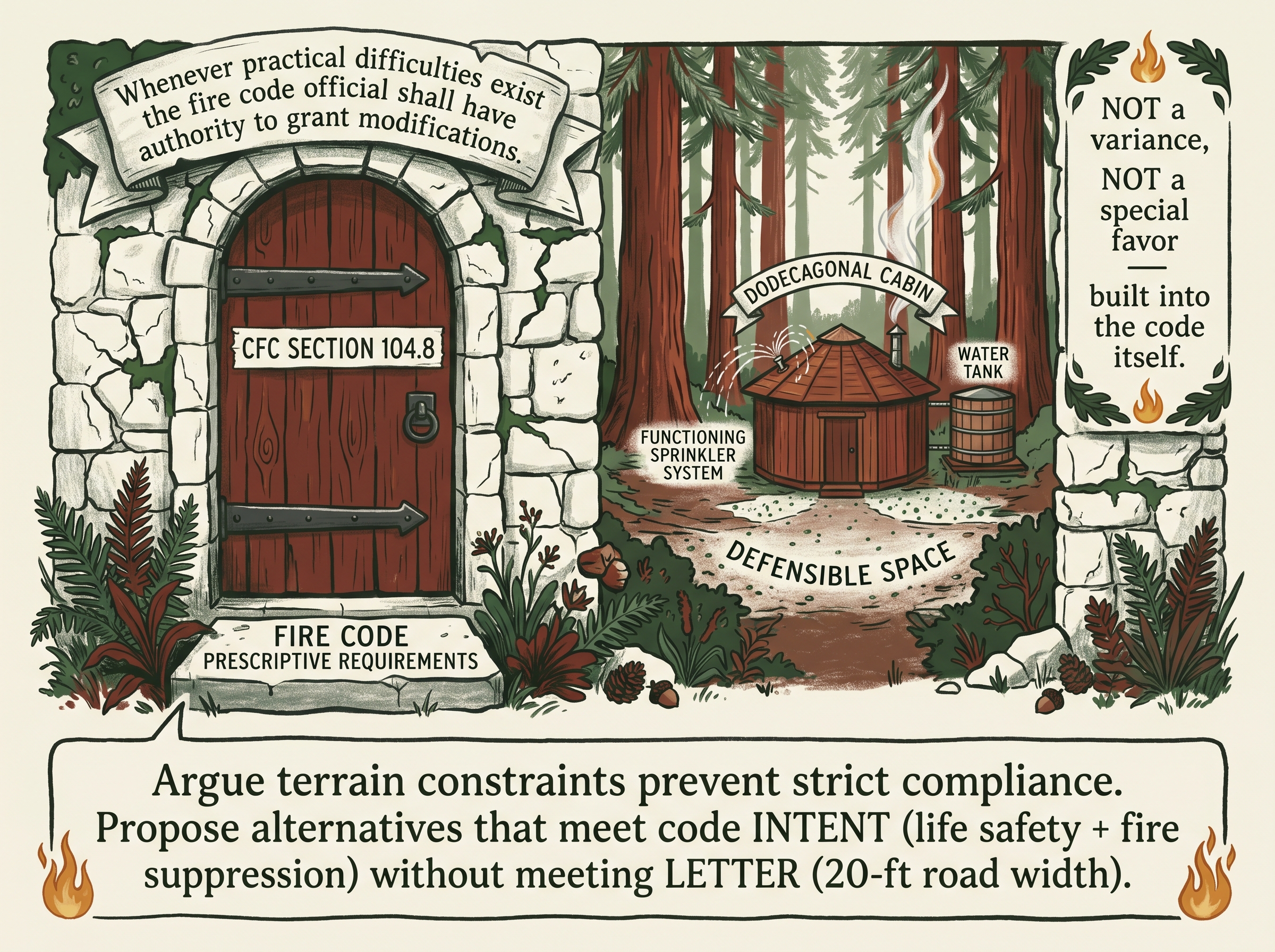
CFC §104.8 gives the fire code official authority to grant modifications "whenever there are practical difficulties involved in carrying out the provisions of this code." This is a code-provided alternative-compliance mechanism — not a special favor and not a variance. Argue that topographic constraints prevent strict compliance, and propose alternatives that meet the code's intent (life safety + fire suppression) without meeting its letter (the 20-ft road width).
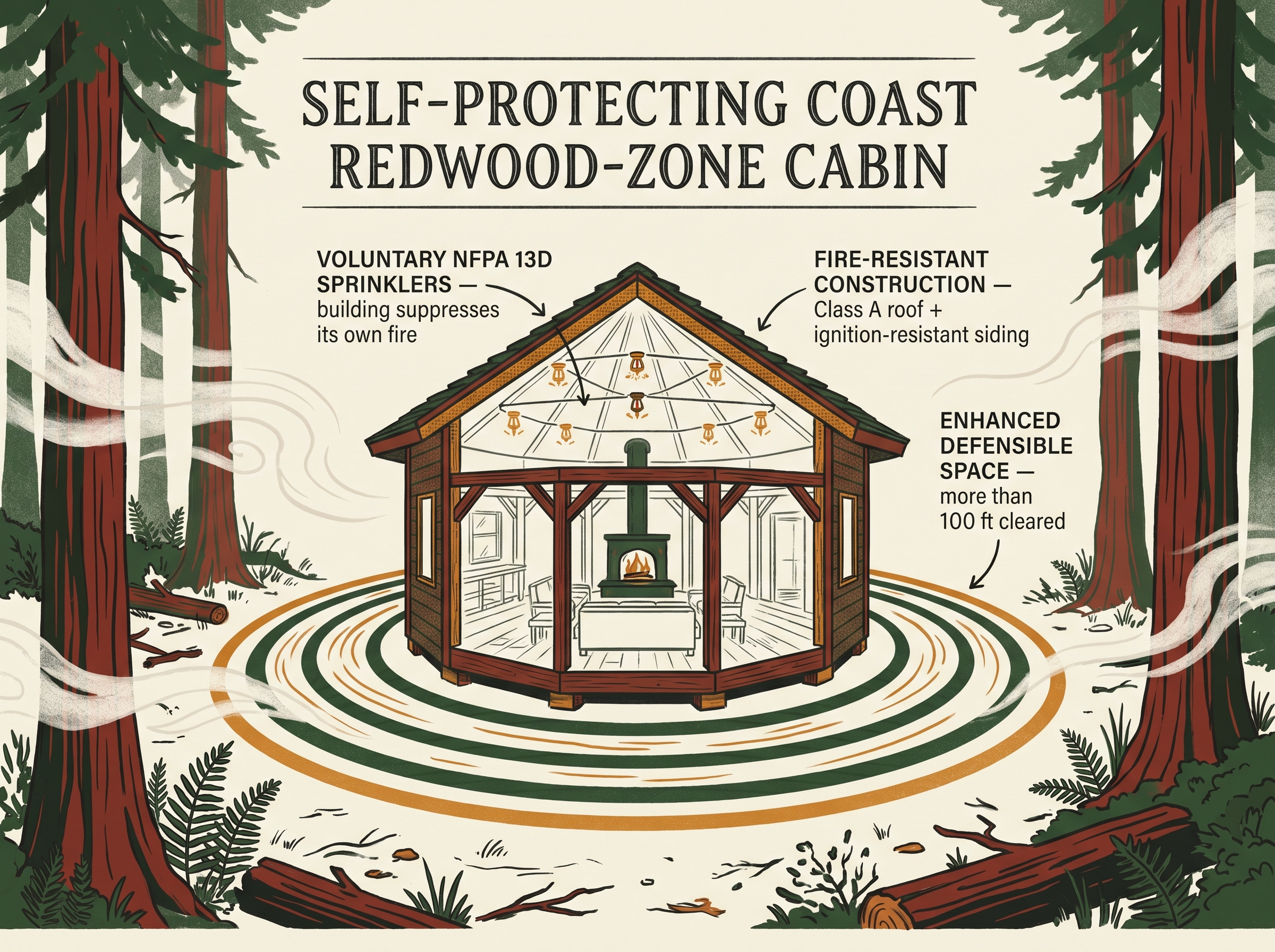
2. Make the building self-protecting
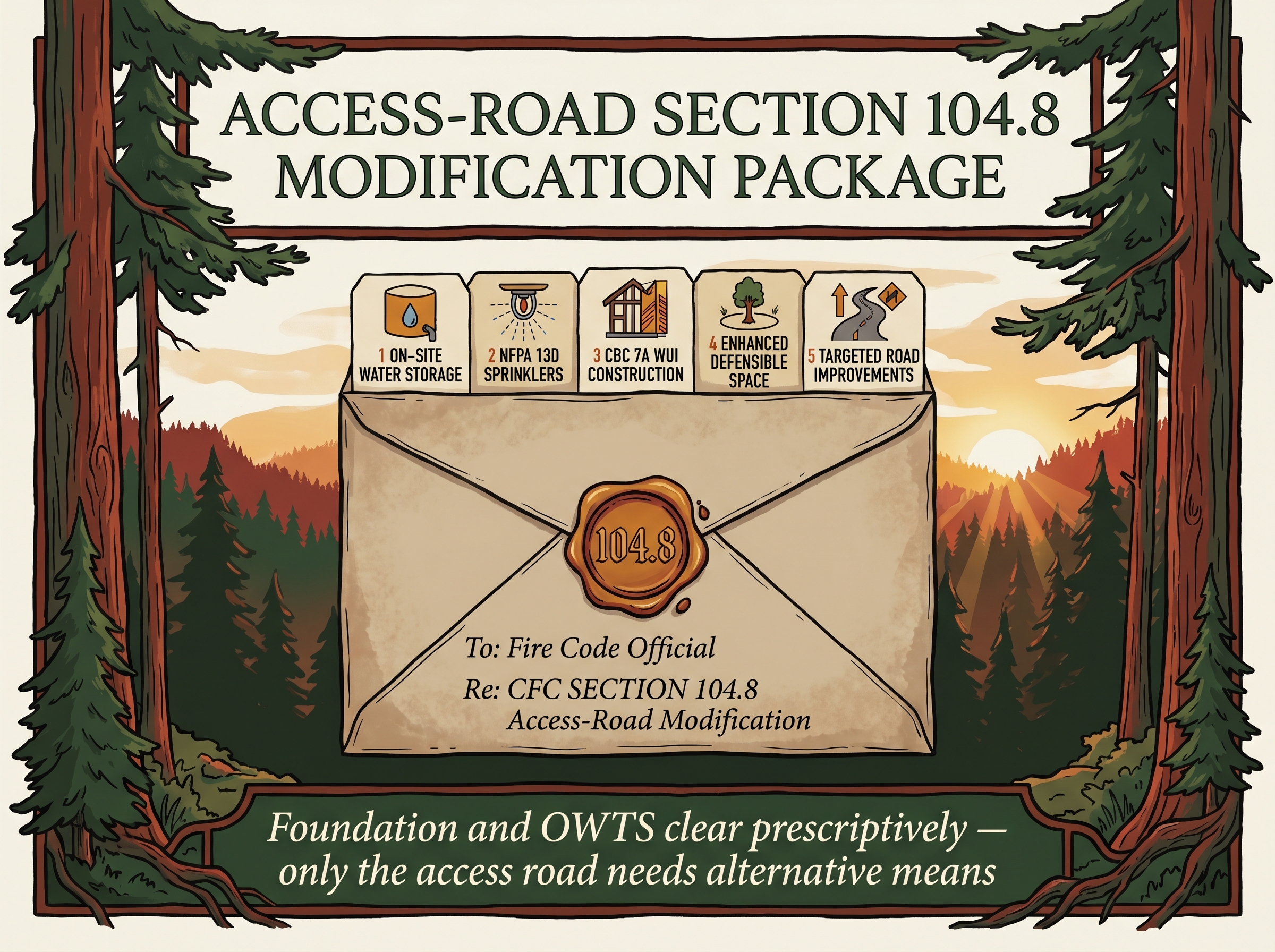
| Measure | Effect |
|---|---|
| Voluntary NFPA 13D fire sprinklers | Building suppresses its own fire without apparatus on scene |
| CBC Chapter 7A WUI construction (Class A roof + ignition-resistant assemblies) | Resists ignition from embers and radiant heat |
| Enhanced defensible space beyond the 100-ft baseline | Fire has a harder time reaching the structure |
If the building can survive a fire without a truck arriving, the road becomes secondary rather than determinative.
3. Put the water on-site
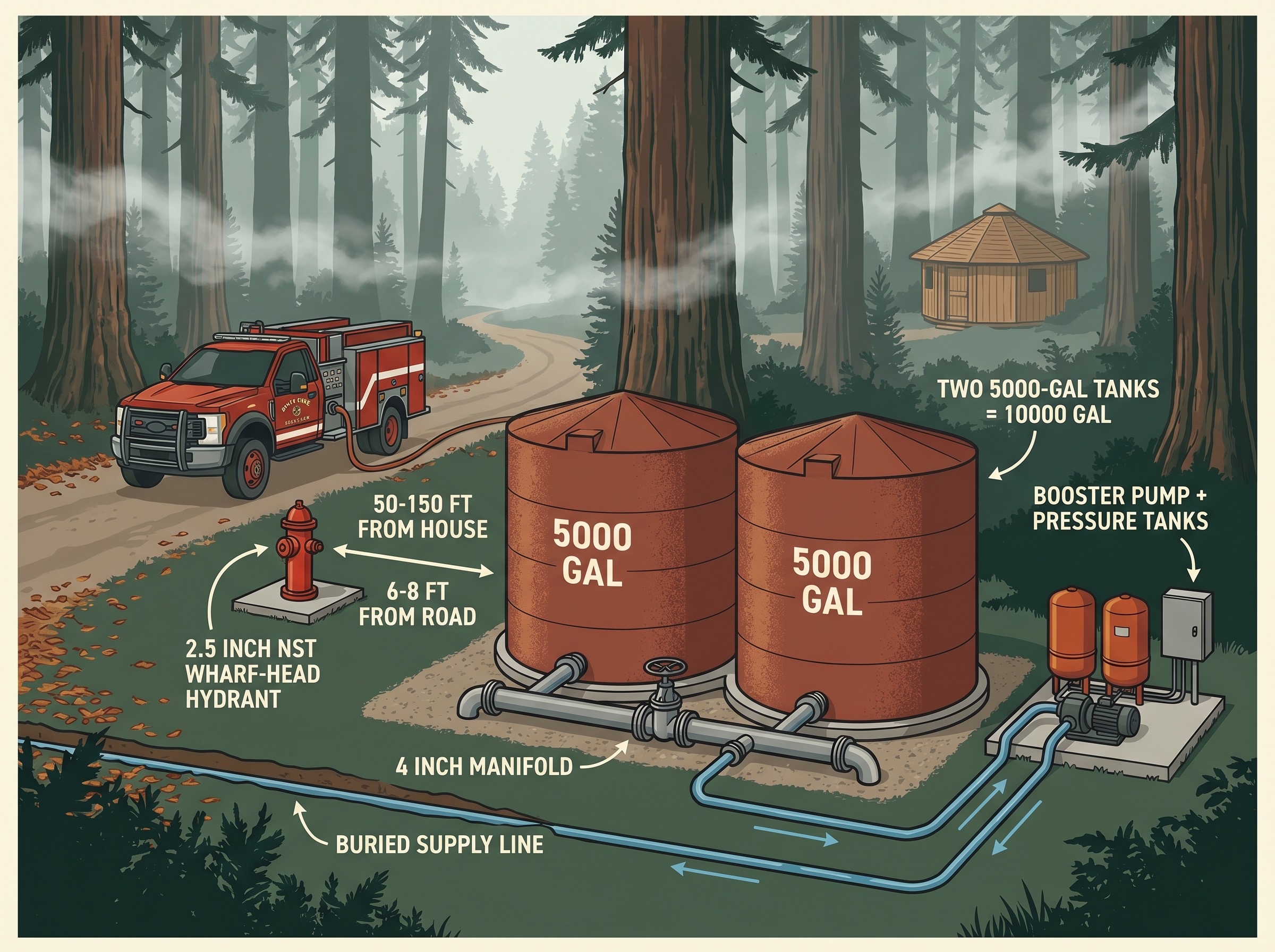
Provide code-minimum fire-water storage in a prescriptive configuration so it clears without a custom engineering submittal. A common pattern is two manifolded tanks summing to the local minimum (e.g. 2 × 5,000 gal to meet a 10,000-gal requirement), feeding a hydrant fitting sized for the apparatus that will actually respond — typically a 2.5″ NST wharf-head hydrant set a short distance off the road. Matching the fitting to the real response apparatus avoids a spec mismatch. A dual-tank detail also often avoids the engineered-foundation trigger that a single large tank would hit.
4. Improve what you can on the road
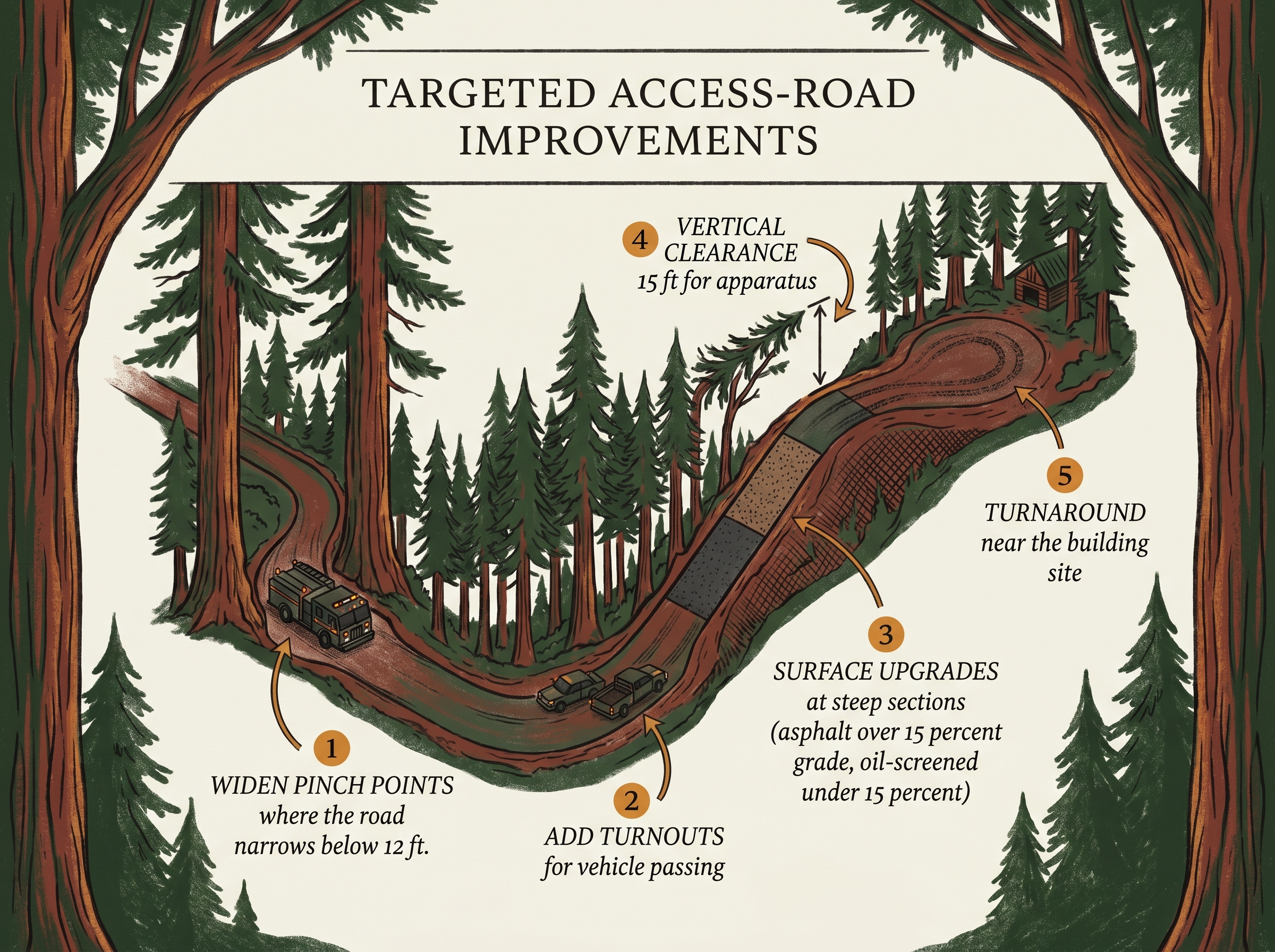
Full 20-ft widening for the entire length is usually impossible. Targeted improvements demonstrate good faith and genuinely help: widen the sub-12-ft pinch points, add turnouts for passing, upgrade the surface for all-weather access, clear vertical clearance to ~15 ft, and add a turnaround near the building so apparatus need not back down a grade.
5. Present as one bundled package
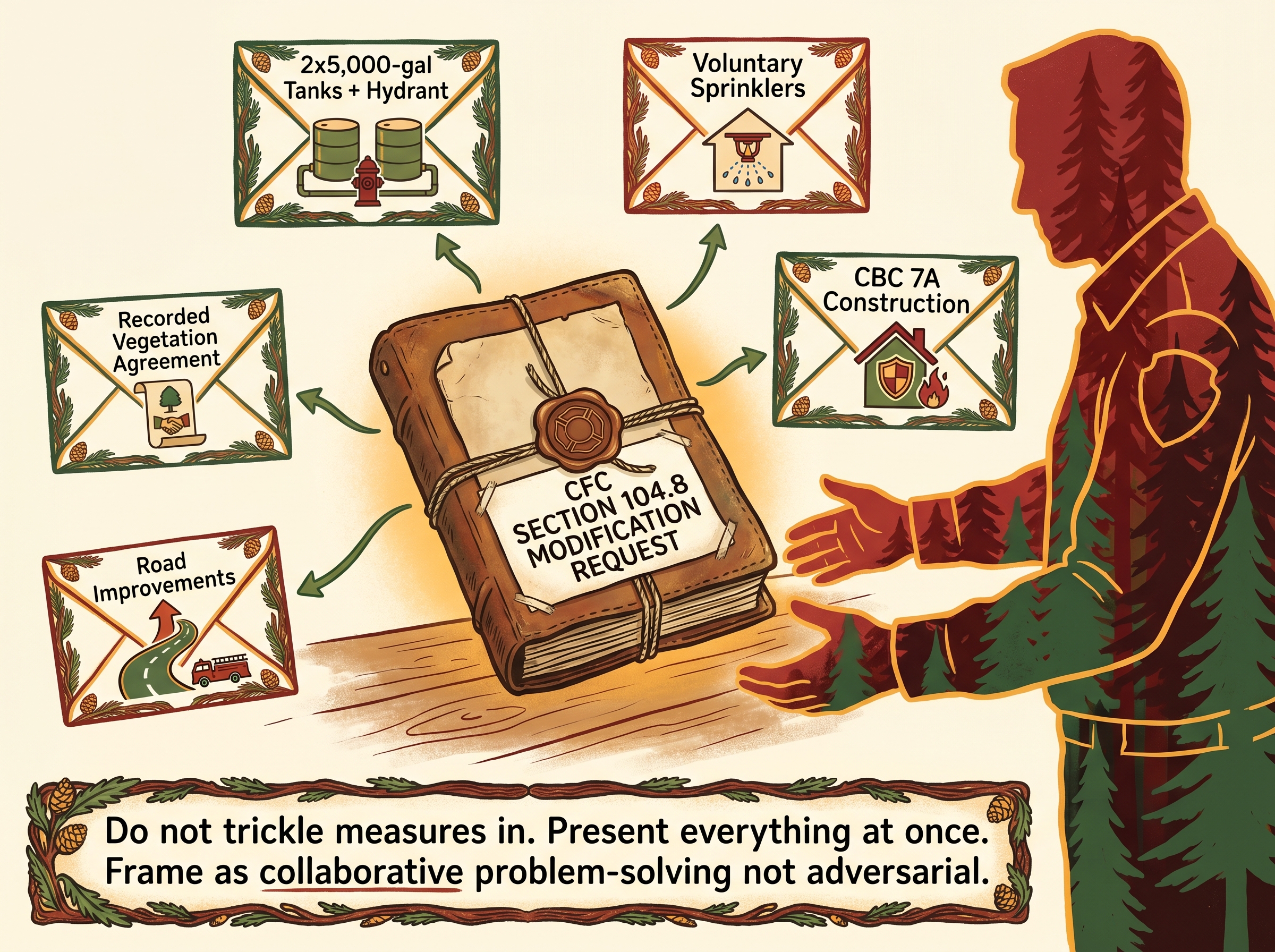
Do not trickle measures in one at a time. Present everything at once at a pre-application meeting, framed as collaborative problem-solving rather than an adversarial demand.
"The road has topographic constraints that prevent full CFC §503 compliance. Here's what I'm proposing instead: code-minimum manifolded water storage with an apparatus-compatible hydrant, voluntary NFPA 13D sprinklers even though the building may be exempt, CBC 7A construction, enhanced defensible space with a recorded maintenance agreement, partial road improvements at the pinch points, a turnaround, and address signage. I'd like to submit a CFC §104.8 modification request. What else would you need to see?"
6. Keep an appeals pathway ready
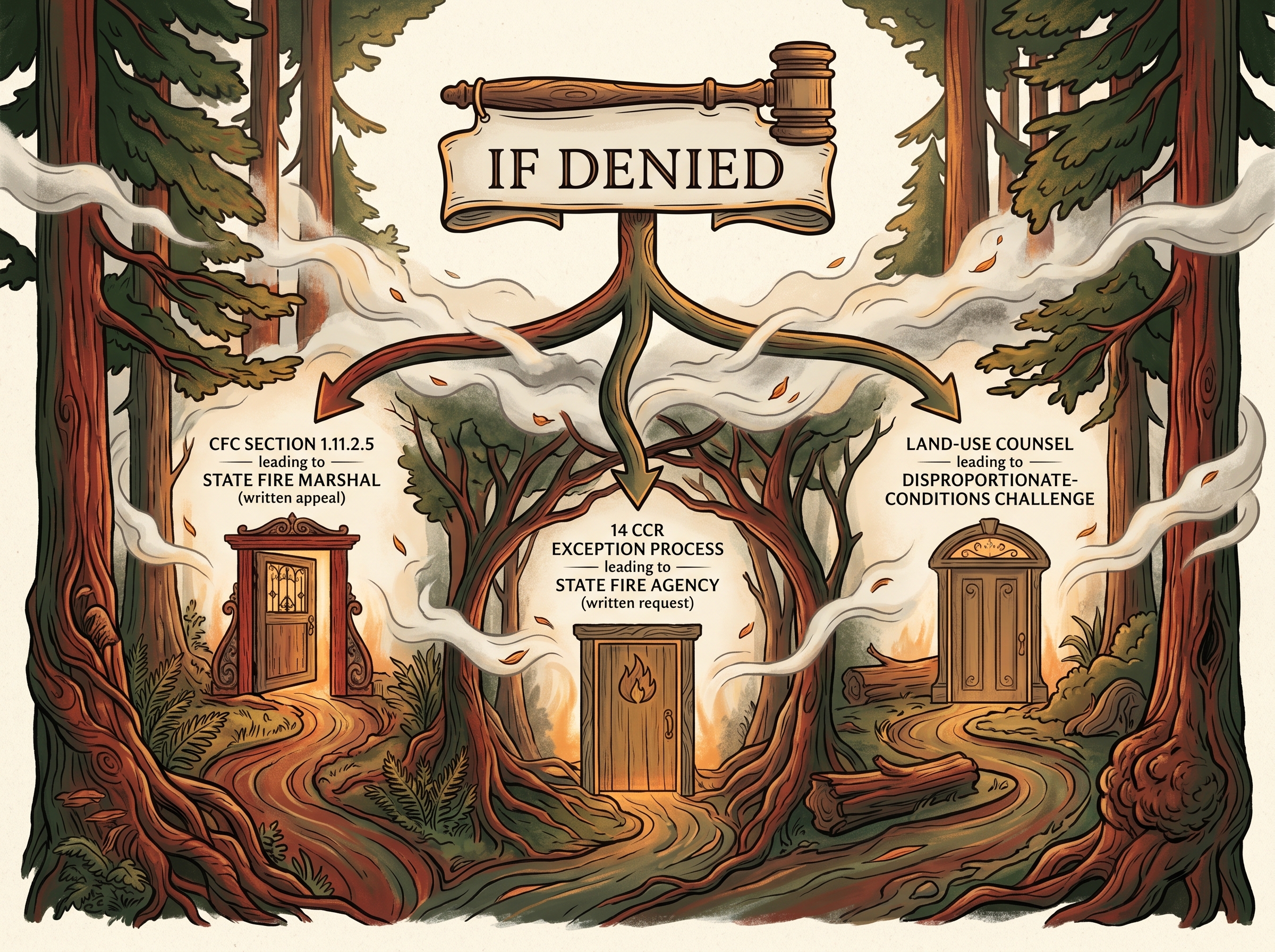
If the modification is denied, know your routes before you need them: a written appeal to the State Fire Marshal (CFC §1.11.2.5); the state fire agency's exception process citing specific sections and proposed alternatives; the building-code appeals forum your county is required to provide (CBC §1.8.8); and, as a last resort, qualified land-use counsel where conditions are grossly disproportionate to the project's actual impact. Lead with collaboration; keep the appeals routes documented in reserve.
Where the cost concentrates
The mitigation envelope is modest relative to full road reconstruction, and it isn't spread evenly. The targeted road work is the largest and most variable element; voluntary sprinklers, on-site water storage, and enhanced defensible space sit in the middle; a recorded maintenance agreement and address signage are minor. CBC 7A fire-resistant construction is folded into the base build rather than added on top. Get local bids before committing — site conditions drive the real numbers.
Owner-builder economics
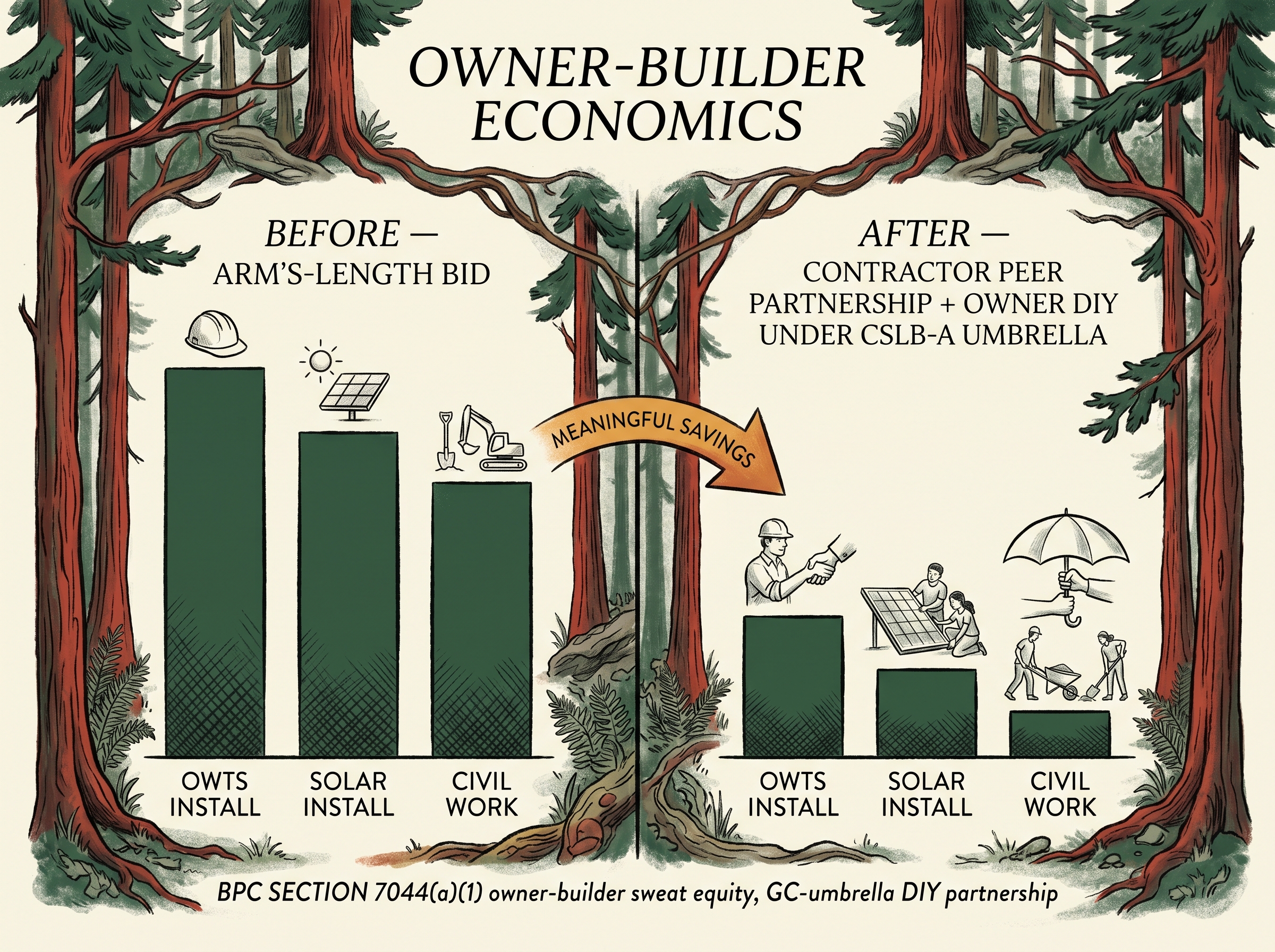
Much of the envelope is install labor. Where the rules allow it, an owner-builder doing sweat equity under a licensed contractor's umbrella (a GC-umbrella DIY partnership) can cut the install-and-solar work meaningfully versus arm's-length bids — freeing money for the road improvements and water storage. Confirm what owner-builder provisions your state and licensing board allow before counting on it.
Strategic context
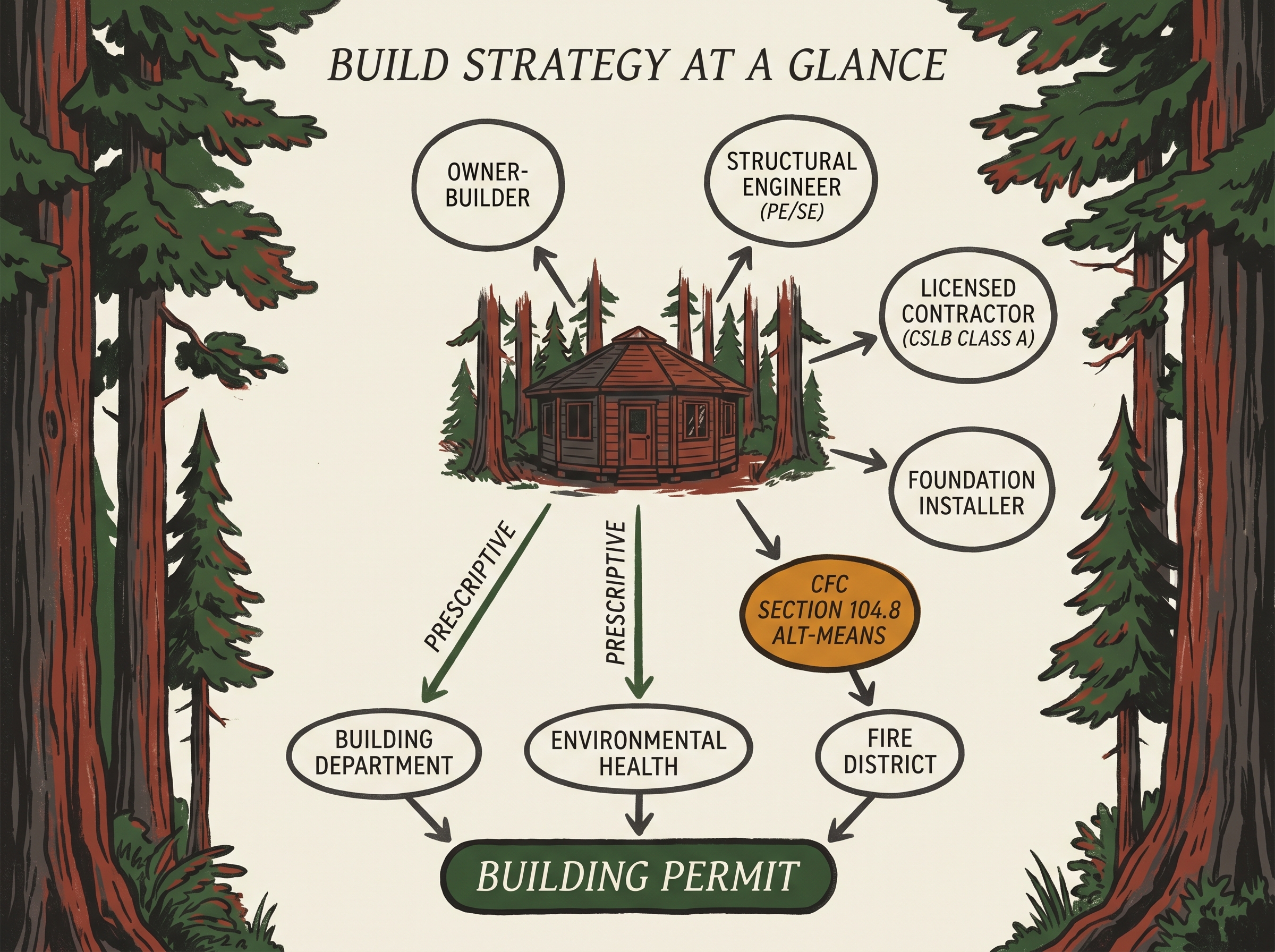
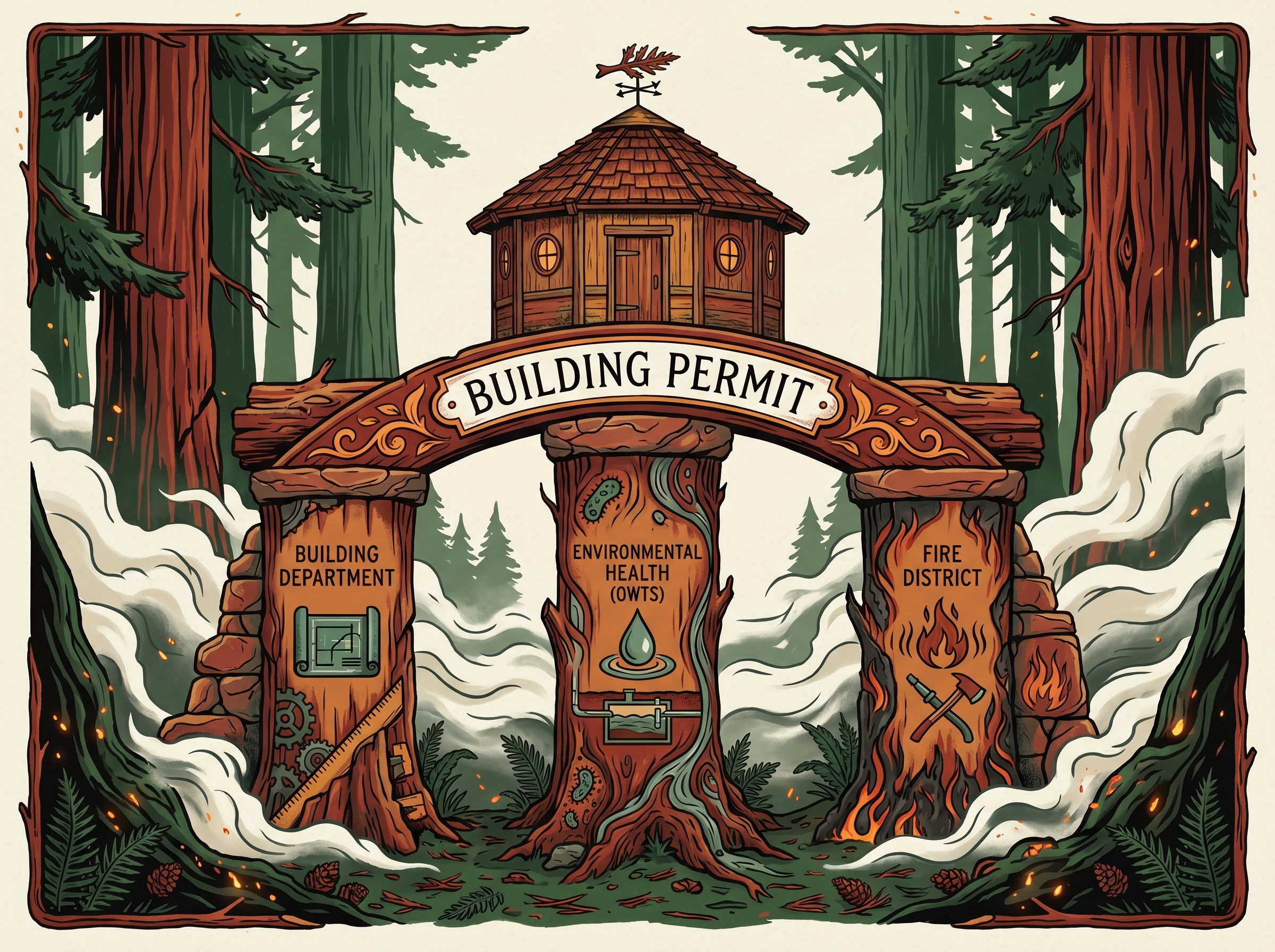
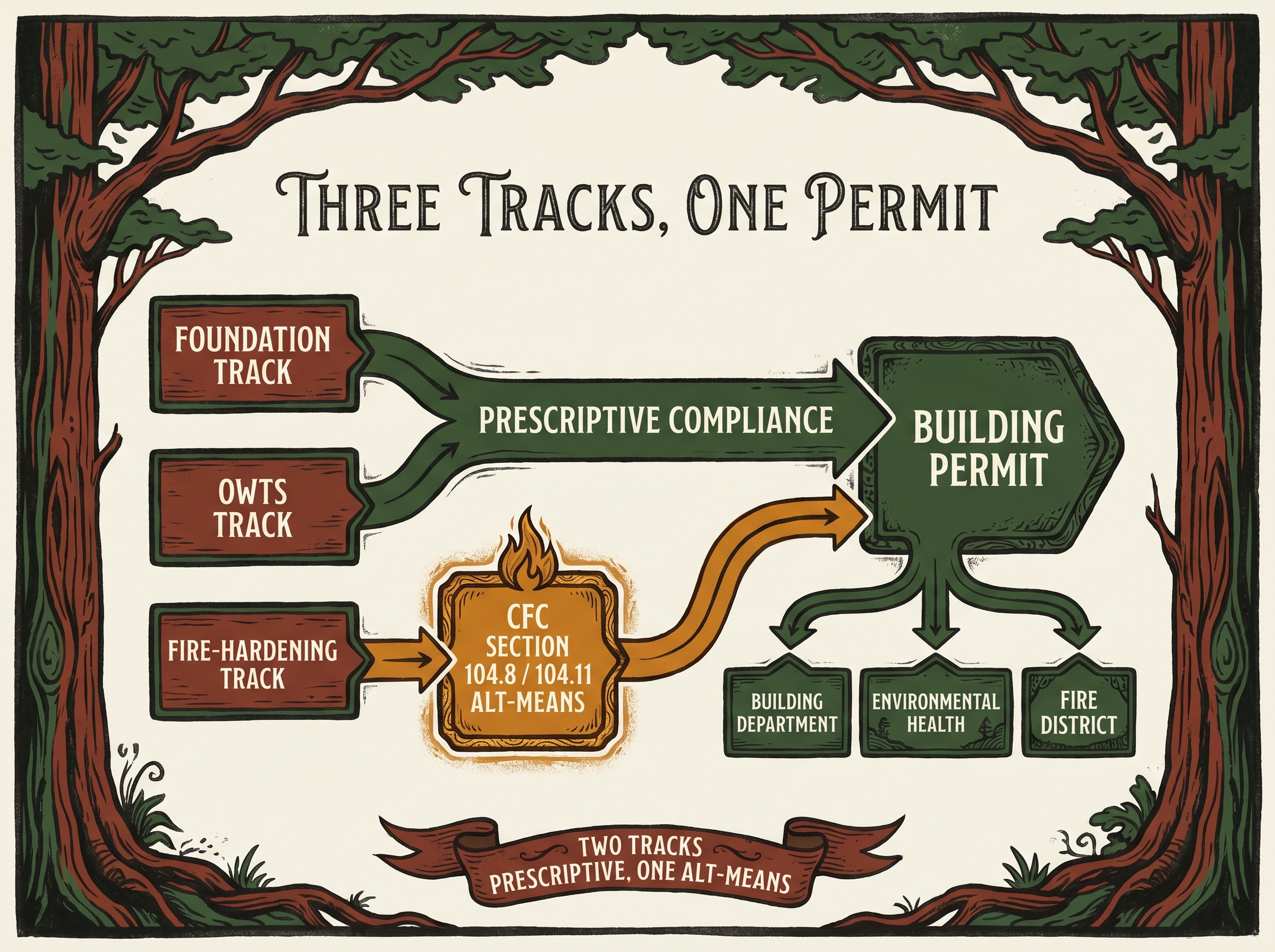
The access-road workaround doesn't stand alone — it's one move inside a larger permitting strategy. Here's how the pieces fit: an owner-builder coordinates a small team (a structural engineer, a licensed contractor, a foundation installer), and three regulatory tracks reach the three reviewers who must all sign off. Crucially, most of the build clears on the ordinary prescriptive path — the foundation (a code-conforming footing) and the on-site wastewater system don't need alternative means. Only the fire / access-road track routes through the §104.8 alternative-means mechanism.
Two doors — CFC §104.8 vs CBC §104.11
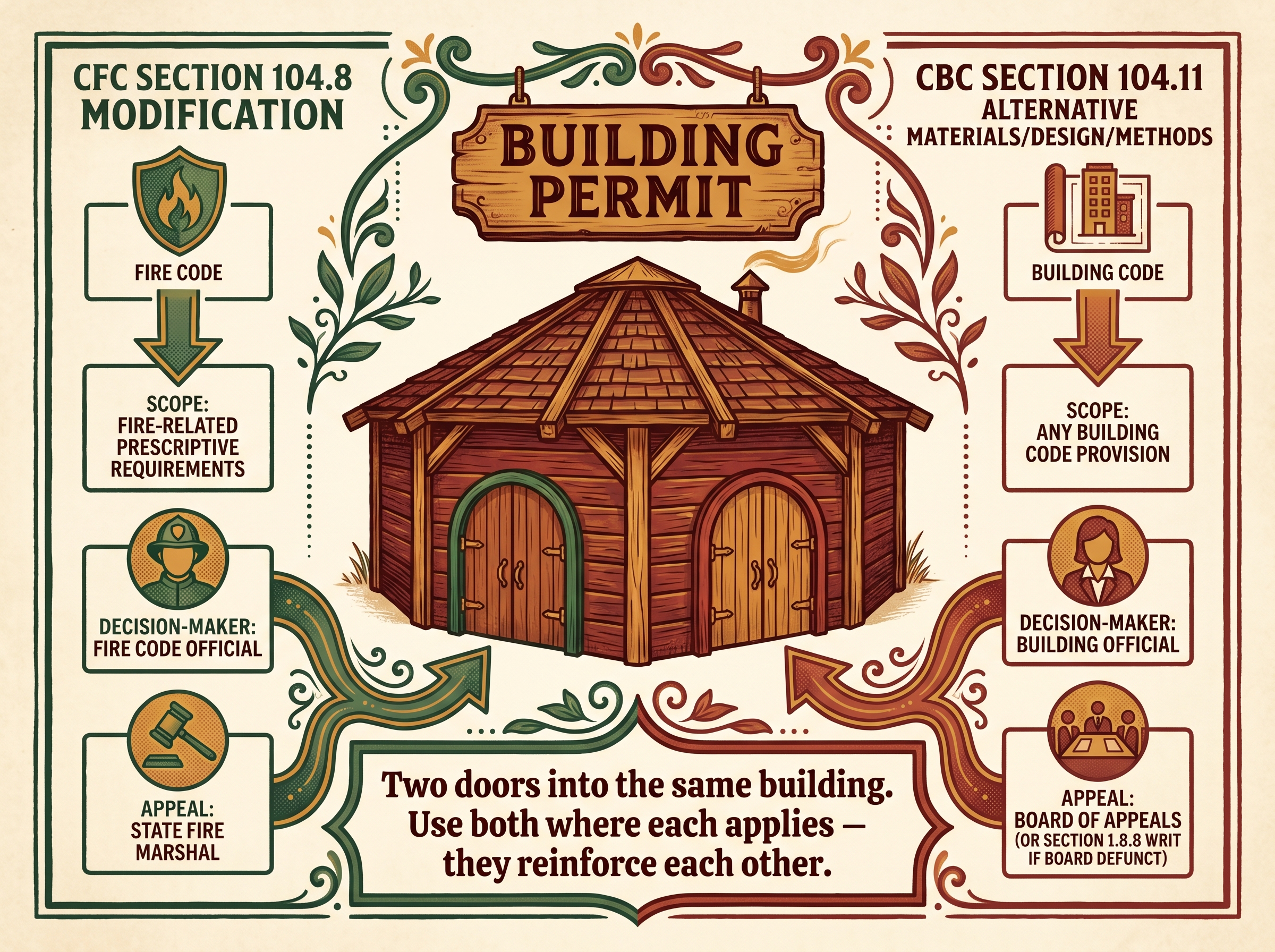
Two related alternative-compliance mechanisms. CFC §104.8 covers modifications to fire-code prescriptive items; CBC §104.11 covers alternative materials, designs, and methods for any building-code provision. Use both where each applies — they reinforce each other.
The three AHJs
A rural building permit generally rests on three pillars, each of which must sign off: the Building Department (structural / general code), Environmental Health (on-site wastewater / OWTS), and the Fire District (access + suppression). The six-layer workaround targets the fire pillar specifically.
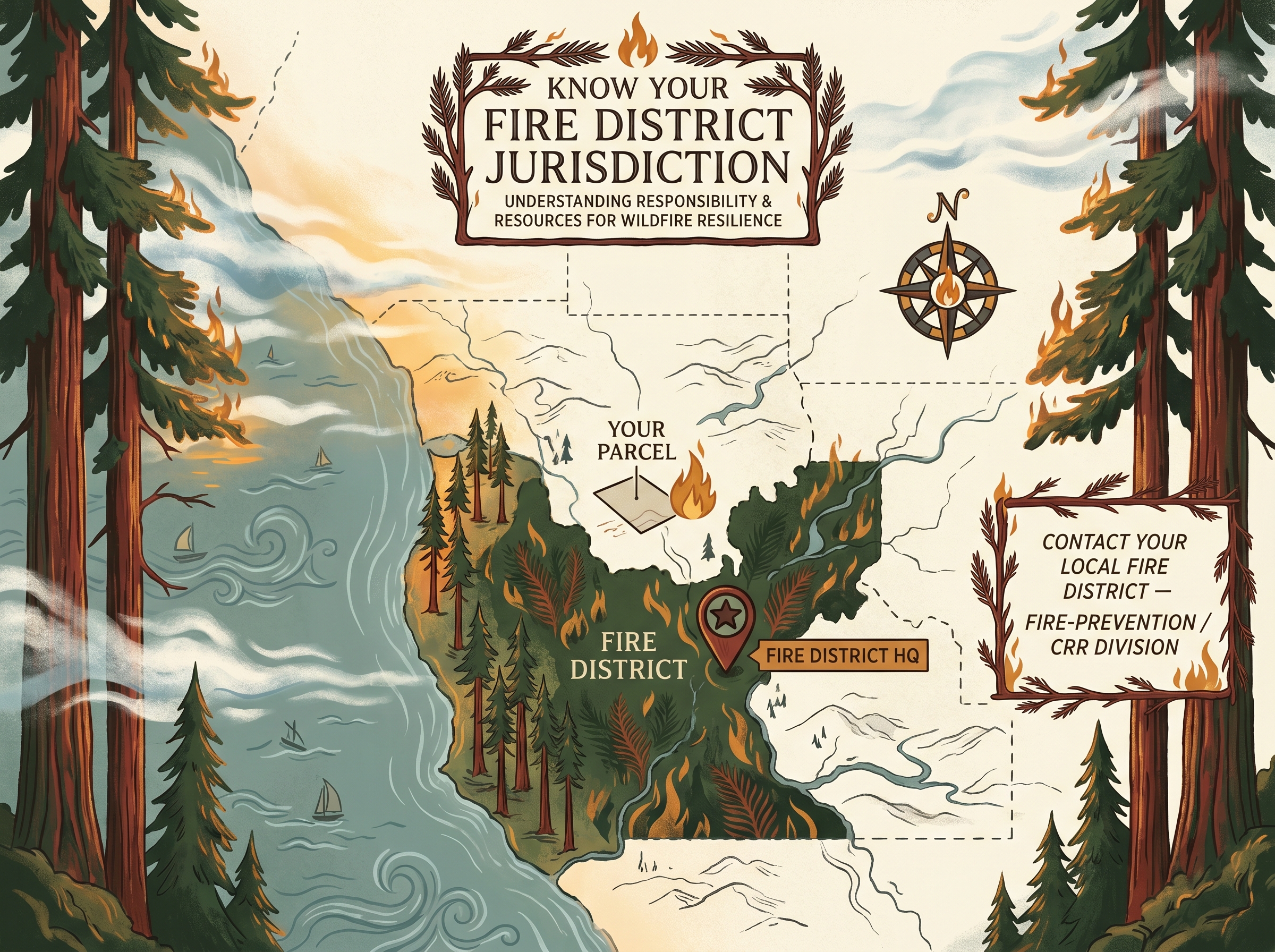
Fire districts often consolidate or re-draw boundaries, so the first task is simply confirming which district has jurisdiction over your parcel and who to talk to in its fire-prevention / community-risk-reduction division.
The access-road modification package
Be clear about what actually needs alternative means. A code-conforming foundation and a standard (or local-program) on-site wastewater system clear on the ordinary prescriptive path — they're engineered and reviewed, but they're not §104.11 alternative-means items. The genuinely non-conforming item is the access road. So rather than a sprawling alt-means bundle, you assemble one focused §104.8 modification package: the request itself plus the mitigation commitments that justify it (on-site water, sprinklers, 7A construction, defensible space, targeted road work).
A note on regulatory load
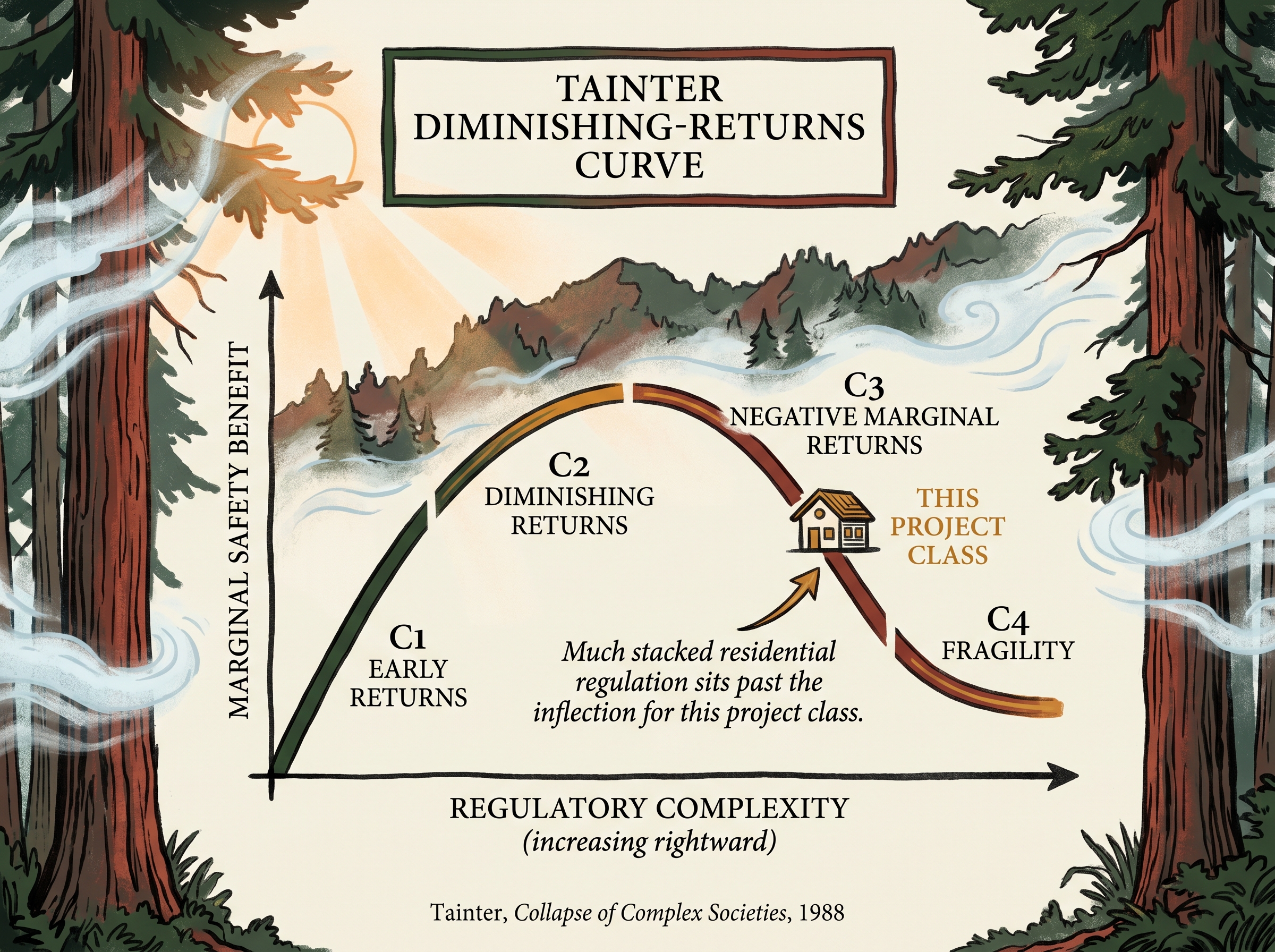
Stacked residential requirements can pass the point of diminishing returns for a small, low-occupancy structure — the marginal safety gain of the last increment of compliance is small relative to its cost. The alternative-means pathways (§104.8 / §104.11) exist precisely as the code's sanctioned "exit" for those cases: meet the intent through a different, often more effective, combination of measures. Joseph Tainter's work on the diminishing returns of complexity is a useful lens for why a well-designed bundle can be more protective per dollar than literal compliance.
Two paths to the permit
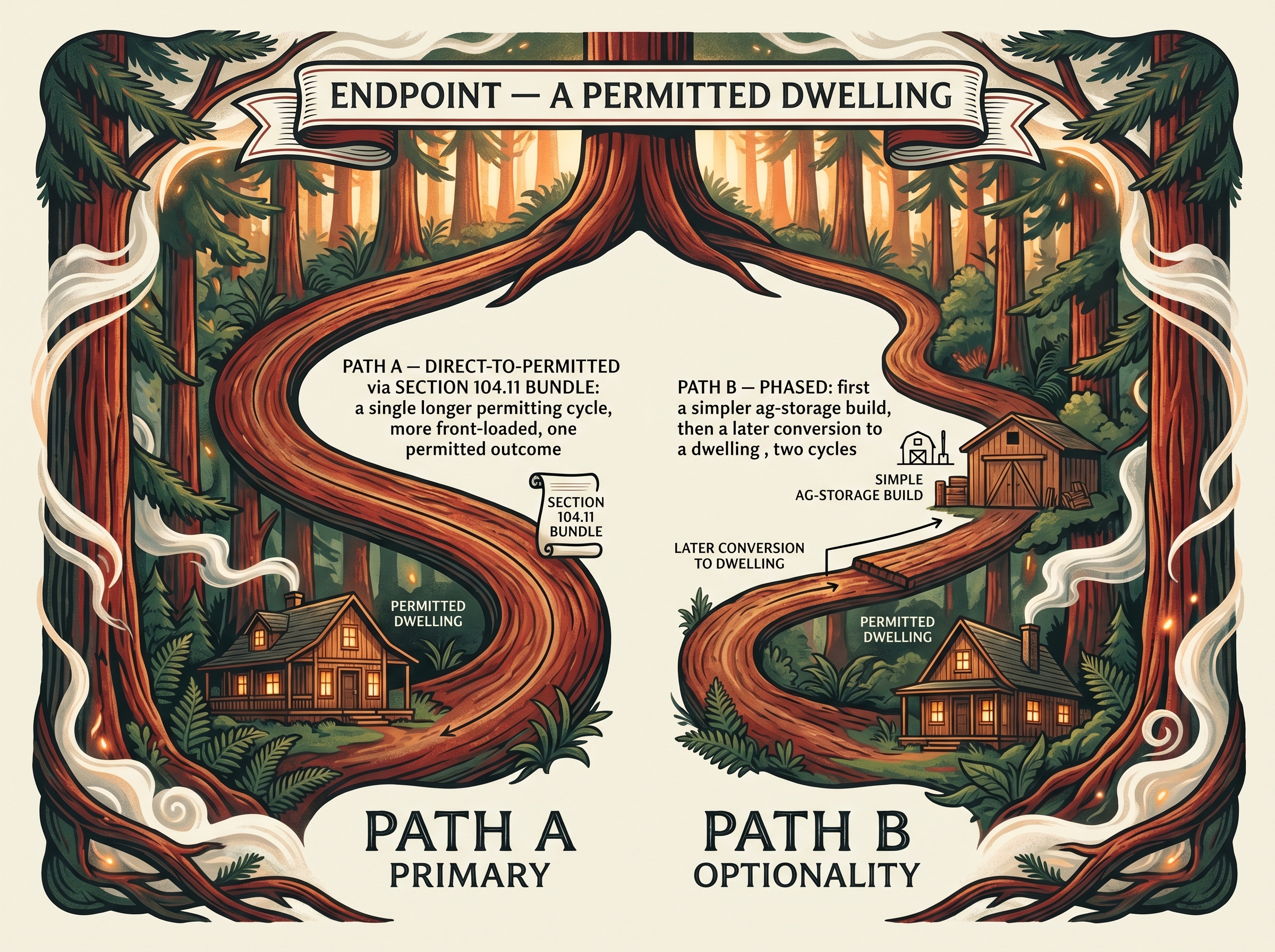
The workaround typically lives inside one of two broader strategies: a direct-to-permitted dwelling path (a single longer cycle, more front-loaded), or a phased path (a simpler ag-storage build first, converted later). The access-road layers serve either one.
Two tracks prescriptive, one alt-means
Foundation, on-site wastewater, and fire-hardening run as three parallel tracks to one permit — but they don't all need the alternative-means door. The foundation and OWTS tracks reach their reviewers on the prescriptive path; only the fire-hardening / access-road track passes through the §104.8 (and, where a building-code item is involved, §104.11) alternative-means mechanism. Keeping the prescriptive items out of the alt-means request keeps it small and focused.
Seen as parallel swim lanes, each track carries its own milestones — and the fire-hardening track is where the six-layer workaround lives. A prescriptive foundation (e.g. a continuous ring footing) can clear on its own, while anything that needs alternative means rides the §104.11 bundle.
How to adapt this to your project
- Confirm the adopted codes for your jurisdiction and edition year — section numbers and amendments drift between cycles.
- Identify your three AHJs and which standard governs each component (especially private vs. public water supply).
- Walk the road and inventory the genuine pinch points; cost the targeted fixes, not a full rebuild.
- Design the self-protection package first — it's what makes the road argument credible.
- Pre-apply. Bring the whole bundle to a pre-application meeting and ask the AHJ what else they need.
- Keep the appeals routes documented but lead with collaboration.
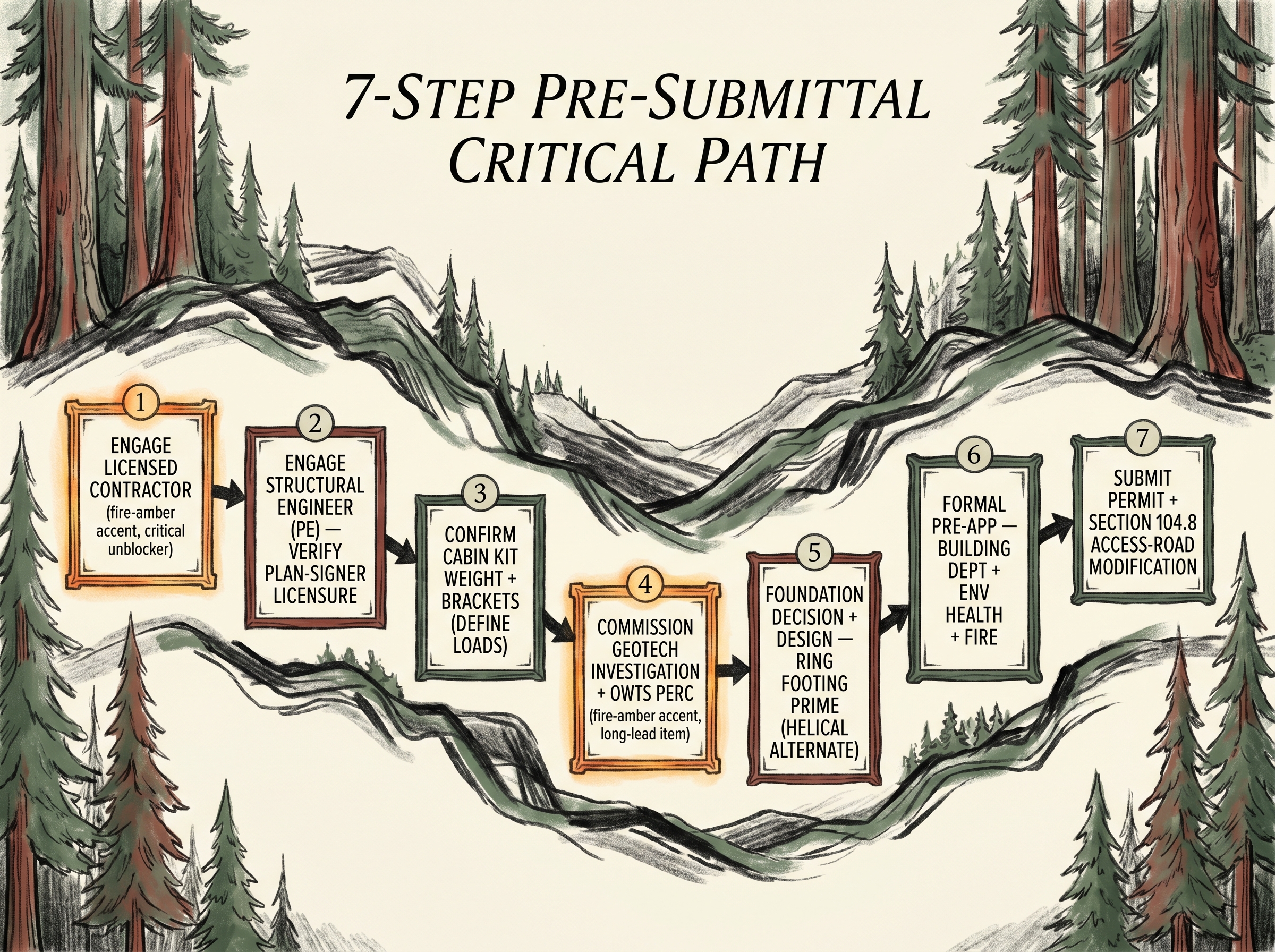
In practice the pre-submittal phase follows a dependency-ordered critical path: engage the team early, then let the loads and the geotech drive the foundation (not the other way around), and finish by submitting the permit with the one genuinely alternative-means piece — the §104.8 access-road modification: